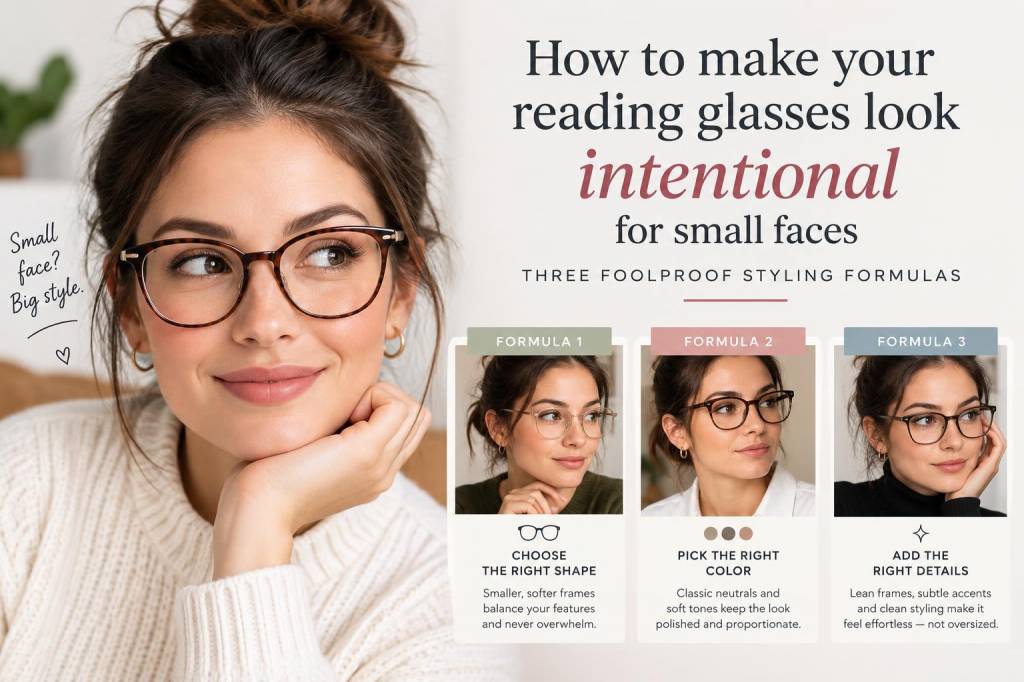
I have small features and, for years, reading glasses felt like an awkward afterthought — something I shoved in the corner of my bag or hid behind my hair. Then I started treating them like any other accessory: something that can be deliberate, flattering and even a little bit fun. Below I share three foolproof styling formulas I use when choosing and wearing reading glasses for small faces, plus practical fitting tips, product suggestions and quick styling moves that make your glasses feel intentional rather than oversized or lost on your face.
Why proportions matter (and how to think about them)
Before we get into the formulas, a quick note about proportions. On a small face, the two most obvious issues are frames that are too wide (they swamp your features) or lenses that are too tall (they cut across your eyebrow or sit too low on your nose). I look for frames that are slim in profile, have a narrow lens width and sit high enough on the bridge to show my eyes and brows.
Practical way to test: try the glasses on and smile. If the frames slide down when you smile or when you look down, they’re probably too big in the bridge or temple length. If your cheeks brush the bottom of the lens when you smile, the lens height is too tall.
Styling formula: The Sleek Minimal
This is my go-to when I want my glasses to feel modern and understated — perfect for work, Zoom calls and days when I want to look put-together without trying too hard.
Why it works: The Sleek Minimal keeps focus on your eyes without overwhelming a small face. I particularly like thin metal frames from brands like Warby Parker (try Petite or sizes labeled 46–48mm) or Oliver Peoples for clean, refined shapes. If you’re buying vintage, look for frames from the ’60s and early ’70s — many were made in smaller proportions.
Styling formula: The Vintage Petite
When I want something with personality — a tiny bit whimsical but still polished — I reach for small vintage-inspired shapes. Think kitten round, keyhole bridges and slightly cat-eye silhouettes sized down.
Why it works: Small vintage shapes add character without competing with your features. I’ve found great petite cat-eyes at Persol (look for smaller sizes) and in markets like Etsy or Depop where sellers often list frame dimensions. When shopping secondhand, ask for the lens width and bridge width — I usually look for lens widths of 44–48mm and bridge widths of 18–20mm for my face.
Styling formula: The Accessorised Charm
If you want glasses to feel intentional and styled, treat them like jewelry. This formula is about pairing frames with accessories and complementary beauty choices.
Why it works: Accessorising makes glasses look like a deliberate style choice rather than a necessity. I love the delicate chains from brands like Miu Miu for dressy days and simple gold chains from Monica Vinader for everyday. A neat tip: use a small dab of clear lacquer on the ends of beaded chains to prevent snagging on hair.
Quick fit checklist (things to ask when trying on or ordering)
| Measurement | Recommended for small faces |
| Lens width | 44–48 mm |
| Bridge width | 16–20 mm |
| Temple length | 130–135 mm (shorter temples sit snugly) |
| Lens height | approx. 30–34 mm for reading glasses |
Ask your optician to adjust the nose pads or temple curve so the glasses sit closer to your face without pinching. Small adjustments make a huge difference: a slight inward bend at the temple ends prevents slipping and keeps the frames proportional.
Styling tips to make glasses feel integrated with your look
On days when I want my glasses to feel extra intentional, I put on a necklace that aligns with the frame’s metal colour and choose a lip shade that complements the frame tone — nothing dramatic, just small echoes that tie the look together.
Where to shop and what to try
For petite sizes, I often check: Warby Parker (try the Petite collection), Zenni Optical for budget-friendly narrower sizes (search by lens width), Oliver Peoples for investment pieces, and secondhand stores or platforms like Etsy and Depop for true vintage finds. If you’re unsure about sizing, pick stores with free returns or a virtual try-on tool.
Finally, remember that making glasses look intentional is mostly about confidence and small details. A good fit, a cohesive colour story, and one or two styling choices (a chain, a hairstyle, a matching accessory) will make reading glasses read as part of your personal style — not something you have to hide.