I always come back from a beach day determined to get the rest of my skincare routine right next time. One sticky tube, one clumpy sunscreen moment and suddenly my skin is covered in tiny white flakes — and my mood is too. After many experiments (and a few ruined SPF moments on sunlit selfies), I've worked out a compact, humidity-proof beach skincare pouch and a simple application order that drastically reduces sunscreen pilling. Below I’m sharing exactly what I pack, why texture matters, and what to do if pilling still happens.
Why sunscreen pills — and why humidity makes it worse
Pilling happens when products don’t layer well: ingredients or film-formers sit on the skin and then cling together into tiny balls as you rub or sweat. Humidity is the culprit because it softens product films, reduces friction but increases tackiness, and makes emollients behave oddly. Silicon-based primers (dimethicone) mixed with heavy creams, or powder over fresh sunscreen, are classic triggers. Add sandy fingers and salty water and you’ve got a recipe for disaster.
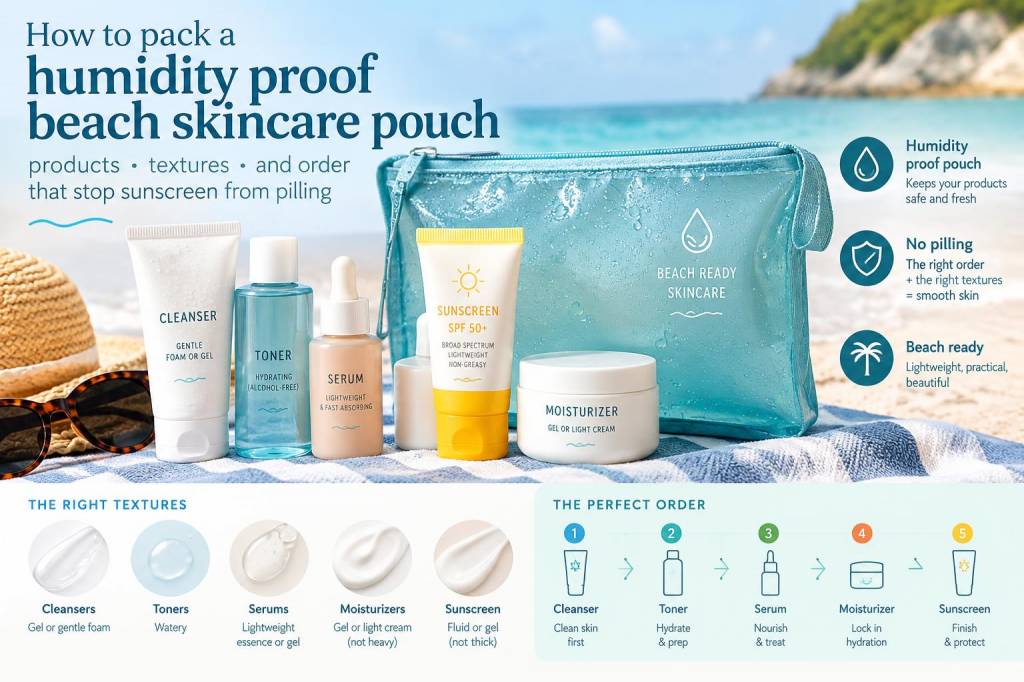
My humidity-proof beach pouch — essentials I always pack
My pouch is small, clear, and zip-locked (I like a reusable waterproof pouch so sand and water can't creep in). Here’s what I slide inside every time:
- Travel sunscreen stick (face) — I prefer a mineral or hybrid stick for touch-ups. Brands I reach for: Supergoop! Play Antioxidant Body Mist for fast reapply and Colorescience Sunforgettable Mineral Brush for quick, dry reapplication.
- Broad-spectrum lotion SPF 30–50 (face and body) — A lightweight chemical or hybrid formula that absorbs without leaving a heavy film. Think La Roche-Posay Anthelios or ISDIN Fusion Water.
- Thin hydrating gel or serum — Something hyaluronic-acid based and lightweight (e.g., The Ordinary Hyaluronic Acid 2% + B5). I use this under sunscreen, not a cream.
- Oil-free moisturizer / gel-cream — Only if my skin is dehydrated. Lightweight textures that sink in quickly; Neutrogena Hydro Boost or Clinique Dramatically Different Hydrating Jelly work well.
- Alcohol-free micellar wipes or gentle cleansing cloths — For sandy hands and quick refreshes before reapplying SPF.
- Small combi kit: powder, blotting papers — A small compact translucent powder or blotting sheets to dab excess shine without rubbing (Fenty Invisimatte blotting paper is a favourite).
- Mini hand sanitiser — Not for skin, but for clean hands before touching your face.
- Silica desiccant sachet — I drop a small one in the pouch to absorb humidity when closed; it helps keep powder products functional.
Texture rules: what plays well together
My golden rule is: light under, filter or film last. Here’s the order of textures that consistently avoids pilling.
- Water-based serums / gels — Apply first. They sink in and give a hydrated base that doesn’t compete with sunscreen film-formers.
- Lightweight oil-free moisturiser (if needed) — Use a thin layer only if your skin feels tight. Avoid thick creams and rich oils on beach days.
- Sunscreen lotion/fluids — The main event. Apply liberally and allow 2–3 minutes to absorb before touching. For me, chemical or hybrid textures that dry down are less likely to pill under humidity than heavy mineral creams — but if you prefer mineral, opt for filtered mineral milks or tinted formulas designed to rub in smoothly.
- Sunscreen stick for reapply — Use on forehead, nose, cheeks with a gentle press-and-blend instead of rubbing. Sticks are less messy and avoid dragging layers around.
- Powder SPF (optional) — Last step and applied with a light hand only if you need a matte finish. Powder is a great top-up over sunscreen if you let the lotion set first.
How I apply at the beach — technique matters
Application technique is the unsung hero. I never rub vigorously at the beach; I press, pat and blend. Here are my steps:
- Wash or wipe sandy areas with a micellar wipe and sanitise hands before touching your face.
- For face: two finger-lengths of sunscreen lotion (about a nickel to quarter-sized amount), warm between palms then press onto forehead, cheeks, nose and chin. Pat to blend; don’t rub hard.
- Wait two to three minutes. I sip water, reapply lip balm with SPF, or tuck my hat on — anything to avoid immediate rubbing.
- For touch-ups after swimming, I use a stick applied in vertical lines and then gently press with fingers or a dry sponge (beauty blender) rather than swiping.
- If I want a matte finish, I blot first with paper then use a translucent powder sparingly with a large fluffy brush.
What to avoid if you hate pilling
Some combinations are almost guaranteed to pill in humid conditions:
- Silicone-heavy primers (deeply slick textures) under heavy creams.
- Rich facial oils directly under chemical sunscreens — they can separate and ball up.
- Rubbing powder over a fresh, tacky sunscreen layer.
- Excessive layering: more than two product layers before SPF is just asking for trouble.
Quick fixes when pilling happens
Despite best efforts, it still happens. My favourite emergency moves:
- Gently pat away with a clean damp cloth — don’t scrub. This removes little pills without taking off all your sunscreen.
- Use micellar wipe to lift residue and reapply sunscreen by pressing, not rubbing.
- If you’ve got powder over pilling, a soft brush can sweep flakes away; then reapply a stick SPF where needed.
Storage tips to keep products behaving in humidity
Humidity can degrade textures in the pouch — here’s how I keep things stable:
- Keep products in a cool, shaded place when possible. I avoid leaving the pouch on the hot sand; I tuck it in my beach bag under a towel or in an insulated cooler bag.
- Replace caps tightly and wipe nozzles after use to prevent clogging or crystallisation.
- Rotate travel sizes seasonally; creams that have been opened for months can separate in heat.
- Keep a silica packet in the pouch during summer months to buffer moisture.
Handy table: quick reference checklist
| Product | Texture | When to use |
| Hydrating gel/serum | Light, water-based | First, pre-SPF |
| Oil-free gel-cream | Thin, non-greasy | If needed, under SPF |
| Sunscreen lotion (face/body) | Fluid, dries down | Main protection, let set 2–3 min |
| Sunscreen stick / powder SPF | Film-forming (stick) / dry (powder) | Top-up only, last step |
| Blotting sheets / translucent powder | Dry | Use for shine control without rubbing |
Beach skincare is equal parts product choice and small rituals. Keep your layers light, let sunscreen settle, clean your hands before touching your face, and choose top-up formats that don’t require heavy rubbing. With a compact humidity-proof pouch and a little patience, you can protect your skin without the pilling battle — and spend the day enjoying sun and sea, not worrying about your SPF.