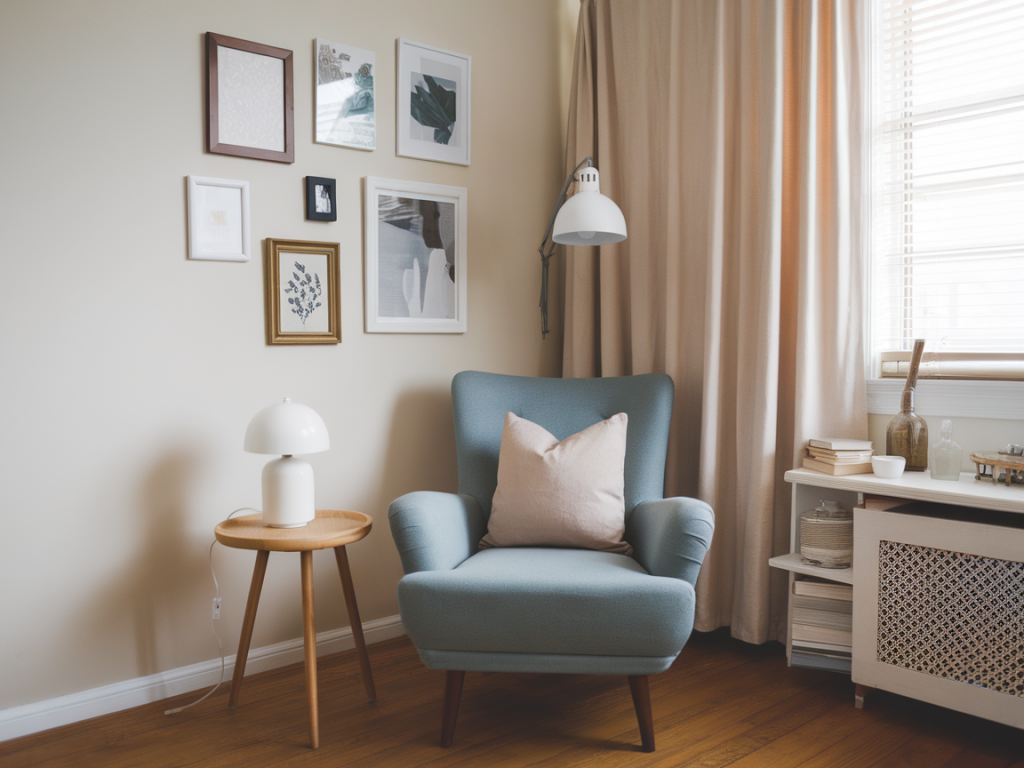
When you live in a small flat, the idea of carving out a calm reading nook can feel impossible — but tiny spaces are often the most forgiving when it comes to creating something intentional. I’ve turned a narrow corner of my own living room into a spot I actually want to sit in for hours: a place for tea, a book, and the kind of quiet that feels like permission. Here’s how I did it on a budget, the furniture choices that make the space feel larger, the lighting that keeps it cozy at night, and one clever storage trick that keeps everything tidy without sacrificing style.
Think small, think flexible: the furniture that works
When furnishing a tiny living room nook, scale is everything. A bulky armchair will drown the corner, but the right-sized seat will invite you in. I went for an armless club chair — compact, comfortable, and easy to tuck into a corner. If you’re shopping, look for pieces described as “slim” or “compact” rather than “standard” or “deep.” Here’s what to consider:
- Seat scale: Choose an armless chair, a slipper chair, or a deep but narrow accent chair (about 70–80cm wide). These have the comfort of a larger armchair without the footprint.
- Multi-use pieces: A bench with a cushion can double as seating and a place to stack books. Ottomans with hidden storage are brilliant for magazines and blankets.
- Lightweight furniture: Furniture with exposed legs (mid-century style or metal frames) keeps sightlines open and makes the room feel airier.
- Secondhand finds: Charity shops, Facebook Marketplace and Etsy are my go-tos — an old armchair can be recovered or refreshed with a removable slipcover to look modern for very little.
For a side table, think slim and tall rather than short and wide. A narrow console or a simple round table (about 35–40cm diameter) is perfect for a cup of tea and a reading lamp. I’ve used a small nesting table set from IKEA (the LÅNGFJÄLL-like styles) and it works brilliantly because the tables can be separated when guests arrive.
Layer your lighting for comfort and flexibility
Good lighting transforms a nook from “dim corner” to “welcoming retreat.” I aim for three layers: ambient, task, and accent.
- Ambient: Warm bulbs (around 2700K) in a ceiling fixture or a floor lamp set the overall tone. Use LED bulbs with a soft glow rather than stark white light.
- Task: A dedicated reading lamp is essential. I love adjustable arm lamps or swing-arm wall lights mounted beside the chair — they don’t take up table space and you can direct the light exactly where you need it. Budget-friendly picks include clamp lamps or IKEA’s RANARP series.
- Accent: A string of warm fairy lights, a small uplighter behind a plant, or a candle cluster adds depth and softness. These little lights give the nook personality without costing much.
Pro tip: Put your task lamp on a plug-in dimmer or buy a lamp with a built-in dimmer so you can soften the light for evening reading without changing bulbs. I changed from a harsh bedside lamp to one with a 3-step dimmer and it made the whole corner feel more intentional.
Textiles and colour: make it feel like an embrace
Textiles are the quickest way to add comfort and cohesion. A small area rug anchors the nook and separates it from the rest of the living room. Aim for a rug that’s large enough for at least the front legs of the chair and the side table — usually 120 × 170cm in a tiny room.
- Throw blanket: Keep a soft throw on the back of the chair; a knitted or fleece throw makes the spot instantly inviting.
- Cushions: One supportive cushion for your back and one decorative cushion are enough. Choose fabrics that feel tactile — linen, wool, or cotton blends.
- Colour palette: I advise two neutrals plus one accent. In my nook that’s warm cream, soft grey, and a muted terracotta for personality. This keeps things calm but not flat.
One storage trick that changes everything
My favourite inexpensive trick is a vertical magazine rack mounted beside or behind the chair. This does three things: it keeps books and current reads at arm’s reach, frees up table space, and uses wall real estate you probably didn’t realise you had. I use a slim wall-mounted wooden rack (think IKEA BJURSTA-style simplicity or a handmade pine rack) so books sit face-out or spined-up depending on the size.
If wall mounting isn’t possible, a narrow ladder shelf that leans against the wall works equally well. Use the lower rungs for woven baskets to hide chargers, notebooks, and small extras. The key is vertical storage: we’re using height rather than floor space, which preserves the feeling of openness.
Styling details that make a nook feel curated
Those little finishing touches are what make the nook feel like yours. I keep a small tray for my mug and spectacles, a ceramic dish for bookmarks and hair ties, and a tiny plant or a single-stem vase to add life without clutter.
- Rotate a small stack: Keep a rotating pile of three to five books on the side table — not too many, but enough to look lived-in.
- Use scent sparingly: A soy candle or a reed diffuser set to a subtle scent (linen, lavender or cedar) elevates the mood without overpowering the space.
- Personal touch: Pop one framed photo or postcard on the wall — it keeps the corner personal without turning it into a shrine.
Layout and practical measurements
Before you buy anything, measure. A quick measuring checklist I use:
- The width of the available corner (aim for at least 80cm for a small chair).
- Distance from chair to lamp (60–75cm is good for a side table + reading light combo).
- Rug size relative to chair (front legs on the rug, or rug positioned so it peeks out a minimum of 20–30cm around the furniture).
Working within measurements prevents impulse buys that won’t fit and keeps the space feeling balanced.
Creating a calm reading nook in a small living room is less about expensive pieces and more about the right choices: scale, layered lighting, comforting textiles and a smart vertical storage trick that keeps clutter at bay. With a few carefully chosen items and a bit of measuring, you can carve out a corner that feels like a private retreat — and you don’t need to spend much to get there.